There is a type of light that cannot be corrected by lowering your head or putting a hand in front of your eyes.
It is the glare — that flat, white blade that bounces off the water, the asphalt, the hood of a car. It doesn't come from just one direction: it comes from everywhere the surface is horizontal and shiny. At the sea with the sun high and the water reflecting, it is the most difficult visual condition that exists. The eyes become fatigued, vision loses contrast, the background disappears under a layer of useless light.
A dark lens reduces everything indiscriminately. A polarized lens does something different: it recognizes where the problem comes from and blocks it at the source.
WHY THE REFLECTION IS HORIZONTAL LIGHT
The sunlight oscillates in all directions: vertical, horizontal, diagonal. When it hits a flat surface — water, snow, the windshield — the physics of reflection causes the bounced light to predominantly orient itself horizontally.
That horizontal light is the glare. It doesn't provide useful information for vision — it doesn't help you see the bottom better, it doesn't assist you in distinguishing the waves, it doesn't tell you anything about what is around you. It just dazzles you.
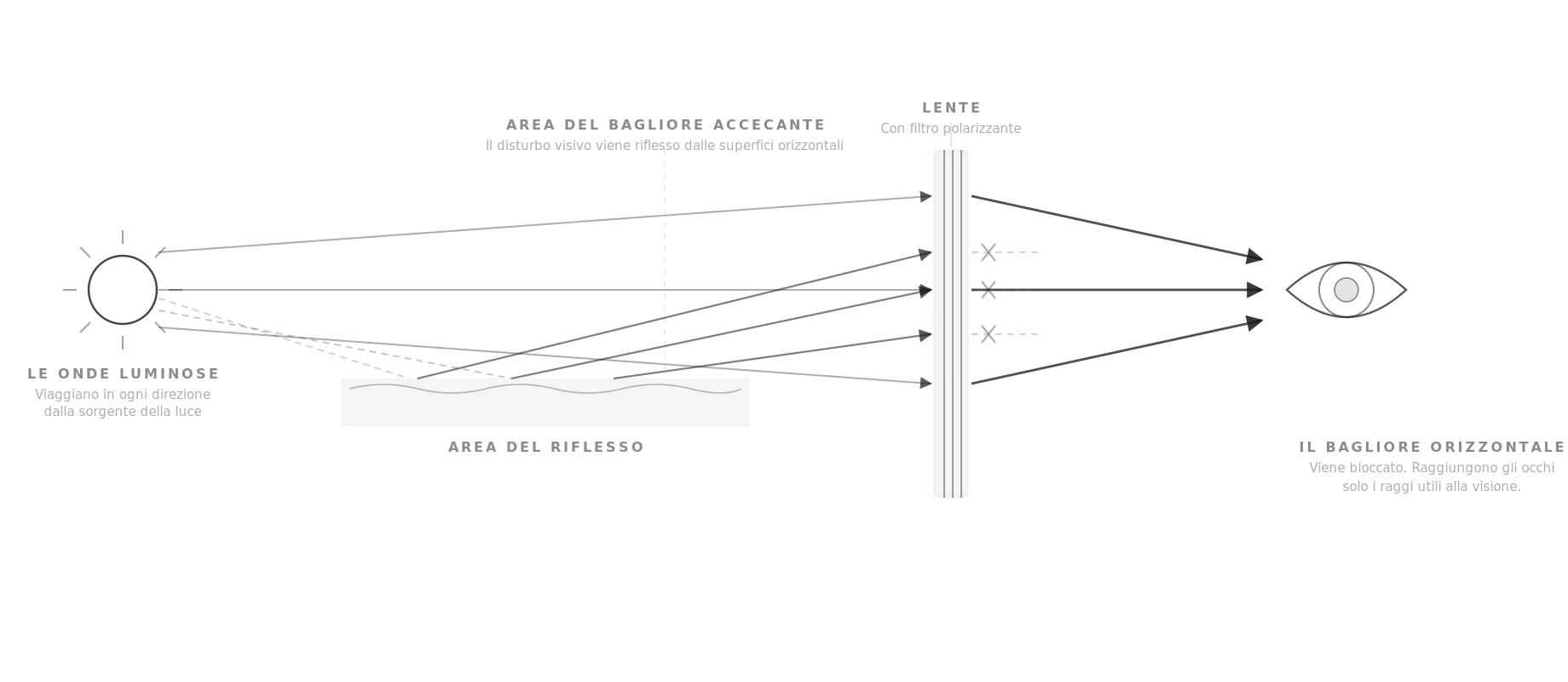
In the drawing, the mechanism is shown: light waves emanate from the sun in every direction, hit the surface of the water, and bounce back as horizontal light towards your eyes. This is the blinding glare. A dark lens allows it to pass through anyway — it halves it, but does not eliminate it. A polarized lens intercepts it before it reaches the retina.
HOW THE POLARIZING FILTER WORKS
Inside the lens, there is a layer of material oriented vertically — like the slats of a Venetian blind positioned upright. This filter allows vertical light to pass through, which is what enables you to see details, colors, and shapes. It blocks horizontal light, which is the light that causes glare.
The result is not a darker view. It is a cleaner view. The sea stops being a white mirror and returns to having color. The seabed is visible. The variations in depth can be distinguished. In a boat, near the rocks or at the entrance of a harbor, this difference is not aesthetic: it is navigation.
The same thing happens on wet asphalt, on snow, on any surface that reflects light horizontally. Polarization is not a luxury for those who engage in extreme sports — it is a precise response to a physical problem that arises every summer, every sunny day, every time you are outdoors near something that sparkles.
HOW TO CHECK IF YOUR GLASSES ARE POLARIZED
It's not written on the front. The color of the lens doesn't say anything. Even a less scrupulous manufacturer can print "polarized" on the case. The way to really verify it takes thirty seconds and doesn't require any special tools.
The screen test. Hold the glasses in front of an LCD screen — a phone works perfectly, as long as it’s not OLED. Look through the lens and slowly rotate the glasses ninety degrees. If the filter is polarizing, the screen will become completely dark at a certain angle of rotation. If the light remains constant regardless of the angle, the lens is not polarized.
The reason is simple: LCD screens emit already polarized light. When the lens filter and the screen filter are perpendicular to each other, they cancel each other out and the screen appears black. It is the same physics that makes polarized lenses effective against glare — applied in reverse.
The two lens test. If you have two pairs of presumably polarized glasses, overlay one lens from one pair onto a lens from the other and rotate them. If both are polarized, at ninety degrees of rotation they will block all light and the glass will become opaque. If one of the two is not polarized, nothing happens.
A LIMIT WORTH KNOWING
Polarized lenses can create interference with some LCD displays — onboard instruments, GPS, the phone mounted on the handlebars or dashboard. At certain angles of rotation, the screen appears dark or with halos. This is not a defect of the lens: it is the same physical property that blocks glare, applied to a light source that we did not want to block.
Those who navigate with important digital instruments already know this. For everyone else, it's useful to know it before making a choice.
NOT ALL POLARIZED LENSES ARE THE SAME
The polarizing filter can be glued as a thin film on the surface of the lens — it deteriorates over time, peels off, and loses effectiveness. Alternatively, it can be integrated into the material during production. The difference is not visible, but it is felt after a few years of use.
On the color of the tint: gray lenses maintain natural colors — ideal for those on a boat because they do not alter the perception of the sea and sky. Brown lenses increase contrast, great for fishing and cycling. Yellow or orange lenses are for low light or foggy conditions.
For those who spend their days on the water, gray is almost always the most functional choice.
Do you want to know if the lenses you have really protect you — or choose the right ones for the upcoming season? In our workshop, we do the test in two minutes and, if needed, we can mount quality polarized lenses on any frame. Even yours, even if it's not Barriqule.